ArtTiVi has been added to the Art TV links to the right.
Saturday, April 12, 2008


Monday, April 7, 2008
 Truman Marquez', Some People Never Go Crazy,
prior to "Context" deconstruction exhibition
 While the opening night deconstruction offers a public gifting of the art segments,
Artists and collectors alike often speak of the last great “movement” in art and the next. Perhaps the “movement” we are in the midst of today is the “Commercialism Movement”. No matter what the astronomical price of the week, we can rest assured it has been artificially driven and inflated by the “king makers” ie. the dealers who guarantee auction houses a minimum for contemporary works sold to establish a market value. While this new paradigm sets the monetary value of fine art, the quality of the art is diminishing. The investment angle has become more monumental than the work itself in our pervasive commercial society. Collectors are buying art with the hopes it will increase in value. They're looking to inflate their egos by owning the next best thing even if they don't like it, respect it or understand it. It is no wonder artist are going of the deep end and making works with dung and bodily fluids or desecrating and gifting art. Buying art for too many is no different for some than buying real estate to flip or commodities trading. As an artist there are days when I’d like to erase the word “market” from the English language and as the recently appointed promoter for painter, Truman Marquez, I understand the art market – like it or not.
Performance art and public gifting of work – a catharsis
An accounting of Context at New Art Center, NY on November 8, 2007
Marquez surrendered himself through the sacrifice of his work (a metaphor of the physical artist’s body and psyche) as an eager audience with disregard enthusiastically carved with a growing hunger like a feeding frenzy of piranha. A few participants abandoned the templates all together and feverishly carved and threaded sliced strips of the canvas intuitively into slits while the greedy covetously removed multiple segments. In a statement Marquez said, “…the paintings are surrogates for the artist, his person, his thought, his creativity. Offering up the canvases to be cut, the artist, metaphorically speaking, offers himself.” This intense emotional experience marks a psychological purging necessary to more clearly define himself and his impending work – a catharsis.
THE WORK
In Severed Voting Fingers Marquez implies a possible conclusion to the Iraq war. The fallen soldier lying dead in the shadows of severed fingers is a metaphor for the ineffectiveness of Western intervention. Furthermore, as a reminder of hopelessness, the crouching Iraqi woman severing her own “voting finger” along with others before her whose severed fingers on the bloody floor cast the shadows, speaks to the fear and uncertainty of democracy and surrender to insurgents. The wall text reveals the number dead and wounded (possibly in vane) while the surface of the painting accentuates dispiritedness of human sacrifice.
Call Me Horse for Now: The artist incorporates the segments of de Kooning, Pollack, Gauguin and Matisse before which are being taken by the figures with jousting poles in harlequin garb who surround a horse (representative of Marquez) charging through the center of the painting. The horse, analogous to the artist seeking direction as he charges away from the painterly elements referencing art history.
Kalashnikov Orb: Nail Rain Series: The depiction of Christianity under threat. A praying figure of a monk crouches near a corner in the shadow of an enormous orb with the lifeless body of Christ appearing in the surface of poles attached to its surface. Within the shadow of the orb’s poles is a hidden image of a Kalashnikov rifle referencing the violence of fundamentalist religious fanatics suggesting the doom of Christianity while nails are weightlessly suspended in a space without gravity of a surreal world.
METAMORPHOSIS
The works of Marquez are compelling on their own exclusive of the performance incorporating the audience deconstruction. Socio-political and religious references swathed in surreal, optical illusions with an emphasis on an intriguing physical and intellectual perspective form a haunting beauty juxtaposed with disturbing grotesqueness. While the deconstruction aspect is essential for the revelation of the supportive work beneath, one might view the performance reprehensible as the unscathed work is significantly compelling on its own. Furthermore, the egregious desecration before preliminary consideration of the imagery is disturbing. Concealed imagery and the consequent artist intent is too easily misunderstood and then in a fleeting moment the ephemeral paintings are gone.
The performances were initiated as a psychological experiment to strip the artist of his control rendering him defenseless and exposed to reach a better understanding of self and artistic direction while perpetuating the public gifting of art and making an important commentary on the "Commercialism Movement". Normally paintings and artists are venerated, untouchable and guarded against mutilation but like a self-inflicted torture, Marquez watched while participants took control allowing himself to become completely exorcised to ultimately reach a catharsis. Marquez’ temporary psychosis spawned by “Contemplate” and “Context” marks a departure as he is resurrected to redefine Truman Marquez. More about the works of Truman Marquez on his Blog.
 While the opening night deconstruction offers a public gifting of the art segments,
 the cut outs reveal wall text and "under-painting" of seated figure shooting himself in the mouth. The figure is presumably the artist "going crazy".
Artists and collectors alike often speak of the last great “movement” in art and the next. Perhaps the “movement” we are in the midst of today is the “Commercialism Movement”. No matter what the astronomical price of the week, we can rest assured it has been artificially driven and inflated by the “king makers” ie. the dealers who guarantee auction houses a minimum for contemporary works sold to establish a market value. While this new paradigm sets the monetary value of fine art, the quality of the art is diminishing. The investment angle has become more monumental than the work itself in our pervasive commercial society. Collectors are buying art with the hopes it will increase in value. They're looking to inflate their egos by owning the next best thing even if they don't like it, respect it or understand it. It is no wonder artist are going of the deep end and making works with dung and bodily fluids or desecrating and gifting art. Buying art for too many is no different for some than buying real estate to flip or commodities trading. As an artist there are days when I’d like to erase the word “market” from the English language and as the recently appointed promoter for painter, Truman Marquez, I understand the art market – like it or not.
I came across the Fine Art Adoption website at DC Art News and found the public gifting of art conceived by NY artist, Adam Simon to be a revolutionary concept. It is a site which hosts portfolios of a select network of artists offering works available for adoption. This has brought an experience from last fall to mind when I met artist, Truman Marquez. It was at his sophomore solo show at CAN NY where the paintings exhibited were deconstructed at the opening. The attendees removed segments of the works with artist issued knives and templates exposing works behind the canvas and leaving the works in ruin on the walls. This public gifting art marked a turning point for Marquez also disgusted with the commercialism of the art world. He, like the creators of fine art adoption are just a few of the many artists and collectors who are disgusted with the “Commercialism Movement”. Below is an article I wrote following “Context” at CAN NY last November.
Performance art and public gifting of work – a catharsis
An accounting of Context at New Art Center, NY on November 8, 2007
THE PERFORMANCE
It was with an authoritative gesture and a sharp blade that Marquez began the performance of his last experimentation with performance art. With irreverent authority he looked away from Call me Horse for Now while cajoling the audience with synthetic exhilaration he made the first decisive and expansive incision. The sound of the canvas tearing resonated like a mortal scream or the first cry of a newborn. Simultaneously the death of the painting surface gave birth to the newly created dissected and deformed works with wall text and secondary imagery. His year’s accomplishment hung mutilated before him as did his psyche when he surrendered control to the audience. This public gifting of art was undoubtedly disturbing for Marquez, exposed and incapacitated, as he and months of his most expressive work lay vulnerable to the desecration before him. The unabashed audience began to remove random pieces of the first canvas and four others with the provided templates and blades. While many coveted the forged segments referencing the masters, Gauguin, Cezanne, de Kooning and Pollock, others became more noticeably intrigued by the secondary works beneath the paintings which emerged with each cut. It was not the deletion of imagery but the addition of the windows which became more vital to the performance and the work as sub-messages in the form of wall text, found objects and paintings relevant to each piece were revealed with successive cuts.
The addition of the secondary plain in Context, contrary to the pure evisceration of work in the first performance, ConTemplate - 2006, contributed a new dimension both physically and intellectually. The participants rewarded with possession of each painting-ectomy were duped as it was evident the nothingness left behind possibly had more relevance to the finished piece and henceforth a greater significance. The removed segments became diminished out of context and of meaningless importance, henceforth value.
The addition of the secondary plain in Context, contrary to the pure evisceration of work in the first performance, ConTemplate - 2006, contributed a new dimension both physically and intellectually. The participants rewarded with possession of each painting-ectomy were duped as it was evident the nothingness left behind possibly had more relevance to the finished piece and henceforth a greater significance. The removed segments became diminished out of context and of meaningless importance, henceforth value.
Marquez surrendered himself through the sacrifice of his work (a metaphor of the physical artist’s body and psyche) as an eager audience with disregard enthusiastically carved with a growing hunger like a feeding frenzy of piranha. A few participants abandoned the templates all together and feverishly carved and threaded sliced strips of the canvas intuitively into slits while the greedy covetously removed multiple segments. In a statement Marquez said, “…the paintings are surrogates for the artist, his person, his thought, his creativity. Offering up the canvases to be cut, the artist, metaphorically speaking, offers himself.” This intense emotional experience marks a psychological purging necessary to more clearly define himself and his impending work – a catharsis.
THE WORK
In Severed Voting Fingers Marquez implies a possible conclusion to the Iraq war. The fallen soldier lying dead in the shadows of severed fingers is a metaphor for the ineffectiveness of Western intervention. Furthermore, as a reminder of hopelessness, the crouching Iraqi woman severing her own “voting finger” along with others before her whose severed fingers on the bloody floor cast the shadows, speaks to the fear and uncertainty of democracy and surrender to insurgents. The wall text reveals the number dead and wounded (possibly in vane) while the surface of the painting accentuates dispiritedness of human sacrifice.
Call Me Horse for Now: The artist incorporates the segments of de Kooning, Pollack, Gauguin and Matisse before which are being taken by the figures with jousting poles in harlequin garb who surround a horse (representative of Marquez) charging through the center of the painting. The horse, analogous to the artist seeking direction as he charges away from the painterly elements referencing art history.
Kalashnikov Orb: Nail Rain Series: The depiction of Christianity under threat. A praying figure of a monk crouches near a corner in the shadow of an enormous orb with the lifeless body of Christ appearing in the surface of poles attached to its surface. Within the shadow of the orb’s poles is a hidden image of a Kalashnikov rifle referencing the violence of fundamentalist religious fanatics suggesting the doom of Christianity while nails are weightlessly suspended in a space without gravity of a surreal world.
METAMORPHOSIS
The works of Marquez are compelling on their own exclusive of the performance incorporating the audience deconstruction. Socio-political and religious references swathed in surreal, optical illusions with an emphasis on an intriguing physical and intellectual perspective form a haunting beauty juxtaposed with disturbing grotesqueness. While the deconstruction aspect is essential for the revelation of the supportive work beneath, one might view the performance reprehensible as the unscathed work is significantly compelling on its own. Furthermore, the egregious desecration before preliminary consideration of the imagery is disturbing. Concealed imagery and the consequent artist intent is too easily misunderstood and then in a fleeting moment the ephemeral paintings are gone.
The performances were initiated as a psychological experiment to strip the artist of his control rendering him defenseless and exposed to reach a better understanding of self and artistic direction while perpetuating the public gifting of art and making an important commentary on the "Commercialism Movement". Normally paintings and artists are venerated, untouchable and guarded against mutilation but like a self-inflicted torture, Marquez watched while participants took control allowing himself to become completely exorcised to ultimately reach a catharsis. Marquez’ temporary psychosis spawned by “Contemplate” and “Context” marks a departure as he is resurrected to redefine Truman Marquez. More about the works of Truman Marquez on his Blog.
Sunday, April 6, 2008

 Ross Neher
Sforza I, 2003, 60"x 115 1/2", oil on canvas
I became familiar with the work of Ross Neher through Ronald Weintraub, a painter in Watermill, who has studied with Neher. It is no surprise Weintraub has acquired such a strong color sensibility having now seen the work of Neher. Additonal works and an essay by Barry Schwabsky about the work is on his official Ross Neher web site where in each work he manipulates of form and space through color in this series of achitectonic, cauffered imagery.
Ross Neher and I almost crossed paths at Pratt Institute. He had just earned his MFA when I was beginning my undergraduate studies there. When I left Pratt in 1980 Neher became Professor of Graduate Painting and continues teaching there today.
Thursday, April 3, 2008
 Geoffrey Baris, Photographer
Many of Baris's images are of water. Water is a constantly moving element, changing form, shape and color. He captures a moment in its continuously changing movement. It is through these frozen moments in time that the movement and reflection of water is transformed into and abstract form.
He uses his eye and the camera to allow the viewer to see another view hidden images that emerge from nature. "The true essence of photography lies beyond pure sight; it goes deeper into the soul, past everything known as color and form. I like to think that my photographs are all real images of natureseen from this deeper place within myself. Here I am able to find my connection to my soul.", says Baris. View more work by Geoffrey Baris.

There are days I feel like I'm swimming upstream tethered to a cinder block. These artists, Madeline Gins and Arakawa, are self inflicting such challenges in their house design in East Hampton. This article by Fred A. Bernstein appeared in today's NY Times. Be sure to click on the link and read the article and watch the slide show.
Tuesday, April 1, 2008
TOP TWENTY-SIX
Marketing Checklist for Fine Artists
Your comments are welcome. Did I leave anything out?
1. Commit at least 8 hours per month to marketing or hire someone who will.
2. Acquire a Business Tax Registration certificate and Sales Tax permit allowing you to purchase supplies wholesale (write off expenses-keep your receipts) and charge sales tax (pay sales tax)if you are self representing.
3. Purchase your domain name (http://www.yourname.com/) and get web design assistance from http://www.websiteforartists.com/ to establish an online portfolio.
4. Hire a photographer or shoot your own work as it is completed.
5. Title your jpegs with your name, title, size, medium with underscores to separate so all the details are in the file name.
6. Juried archival sites like re-title, artists space, white columns and saatchi are good for exposure to other artists and curators. These sites are on the http://www.lynndunham.blogspot.com/ site along with many other useful links. Beware of the company you keep with unjuried sites like boundless gallery, fine art America, paintings direct - just to name a few.
7. Print business cards with your name, address, phone number, email and web address, to distribute.
8. Research galleries, museums and collectors to target and start a data base for mailing and phoning.
9. Beware of "vanity" galleries who ask for membership fees and payment for catalogues. A legitimate gallery which believes in you will be willing to take an up front risk and produce a catalogue at their own expense (or at least split the cost with you), pay for promotional materials and advertising and host an opening. Their investment is recovered in their commission so they have a vested interest in making a sale where as the vanity gallery without an investment has less incentive to promote a sale. If you are involved with a "vanity" gallery, think of it as a venue to show work and be proactive with your own promotion.
10. Beware of artists' coops (or vanity galleries with a large stable of artists) posting calls for entries. The existing artist stable may be guaranteed inclusion in the show. With limited wall space, there might be hundreds or thousands of submissions for only a handful of spots available. No matter how great your work is the odds of inclusive could be low. I know $35 entry fees are small but over and over it adds up so choose wisely.
11. Remember a gallery will sell your work to buyers but if you are seeking vast exposure, you or your publicist will need to sell "you the artist" to multiple galleries. With the internet, global exposure is more attainable than it has ever been. Most galleries will want an exclusive for a geographic area.
12. Negotiate a contract in writing with any gallery or representative with whom you become associated unless you thrive on danger. Don't do business on a hand shake or blind faith! This is a recipe for failure, being taken advantage of possibly legal action which costs more money and produces negative energy.
13. Read to keep informed at ArtCal, Artweek, ArtNews, Art in America, etc. These sites are on the http://www.lynndunham.blogspot.com/ site along with many other useful links.
14. Invest time in promotion or hire someone who will. Prepare collateral materials, send out cds and collateral materials to galleries, follow up by phone, research opportunities, connect with other artist live or virtually. Be sure your website address is published on all communication materials and keep it up to date.
15. Be aware of the local art scene if there is one.
16. Submit work to juried shows with a known juror.
17. Research and apply for grants that might be applicable.
18. Be computer literate. Use contact management software. Stay up-to-date.
19. Set deadlines/goals. Create a strategy to connect with art consultants, curators, galleries, museums with your work or hire someone who will.
20. Continually update your mailing list.
21. Go to openings at galleries who may be interested in your work and leave cards or postcards.
22. Create an Artist's Statement - Your Mantra and maintain an up-to-date bio/resume with exhibitions, education, collectors, and awards received.
23. Create a consignment receipt and bill of sale.
24. Create a pricing formula for your work.
25. Keep a catalogue of resources ie. framers, photographers, packers and shippers, printers, etc.
26. Be prepared for rejection...Don't lose momentum!

 It's Raining at Cooper's beach!
I never really looked at rain drops on the car window until I went to Cooper's Beach this morning to remind myself that I live at the beach. I saw the ocean through the glass and also upside down in the drops. I love the immediacy of a digital camera, since my time in the studio has become so limited. This made me think of Ross Blechner's "cell" works.
Monday, March 31, 2008
 Deborah Simon, Orcas, watercolor and gold
24” w x 36” h, 2004
At the Whitney Biennial, 2008 in the sculpture garden, Fritz Haeg’s Animal Estates recreated twelve indigenous animal habitats, such as a beaver pond, and featured guided tours by local scientists, historians, and artists. Deborah Simon participated with her possum sculpture. More about Simon can be found at Hungry Hyaena or Deborah Simon.
.jpg)
Sunday, March 30, 2008
SOMEONE! Let Me Live Vicariously...
Gallery HD (one of my favorite TV Shows!) and Illuminations Media are seeking two artist candidates to take the shoes of Jack Kerouac and go on an amazing road trip and I'm hoping a blog reading affiliate will help me to live this experience vicariously. Two Artist/Art Racers will cross the US in 40 days, surviving only on Art. Equipped with art materials, cameras and a $1 dollar budget, the Artist/Art Racers are required to “trade” Art for food, shelter and other art -works. Starting on opposite coasts (one in NYC and one in LA), their adventure culminates in a home-city exhibition of all the works they have created and collected along the way. The winner is determined by which Artist sells/trades the most artwork. Here's the "classified" skinny:
Looking for great communicators who interact well with all sorts of people and can make smart commentary as life happens. Intelligent, sassy and witty are good too. All participants must live in the New York or Los Angeles areas, be at least 21 years old and a US citizen or legal resident alien. If this is you, please submit the following:- recent photo (no older than 6 months)- bio or resume- sample of your art (photo reproduction okay)- short essay explaining why you are an Art Racer- be sure to include your full name, home city and phone number. Please send all ASAP to: subs@barbarabarnacasting.com**Bio/Resume & Essay should be in body of email**photo attachments okay ART RACE shoots May 26 – July 11 for appx 40 days on the road + up to 5 add’l shoot days & voice over. Each Art Racer will receive $20,000 US for participating.Production Company is Illuminations Media UK http://www.illuminationsmedia.co.uk/
 I couldn't get a photo of the dollar bill installation which this post is about but I found this dollar bill oragami site with over 100 different dollar sculptures for $7.95. It really is amusing!
 There was a "special project" at the Armory show consisting of 100 framed dollar bills, and a list of the coresponding prices which started at "$100" ($100 for $100!) and priced upwards to "$4,500,000." Red dots indicated sales up to the $289 price . The New York’s 33 Bond, whose exterior booth wall exhibits the work, had no comment on the installation. It was the work of Invisible Heroes, a group of art world hoaxsters provided by Scope organizer, Hubshman to introduce a bit of commerce mockery into the fair. The entry marked "$4,500,000" was marked "reserved." That says it all concerning the commercial state of affairs in the contemporary art market today.
Saturday, March 29, 2008
Worried Dealers, Cross-Dressing Potter
Open Armory Art Fair
By Lindsay Pollock
By Lindsay Pollock
March 27 (Bloomberg) -- Collector Donald B. Marron noticed a less-frenzied pace at New York's Armory Show art fair yesterday as he strolled the aisles during the VIP opening.
``You can see people contemplating the art,'' said Marron, chairman of Lightyear Capital LLC, with his curator at his side. ``It's the way you ought to look at art.''
Following a seven-year jump in prices for contemporary art and a proliferation of international art fairs, the speculative boom may be losing some steam.
``I'm not sure, at the end of the day, how good business is,'' said Roland Augustine, head of the Art Dealers Association of America and co-founder of Chelsea gallery Luhring Augustine, which isn't exhibiting. ``I'm not sure if the market can absorb all this.''
The fair, a showplace for 160 international galleries selling from booths on Pier 94 on the west side of Manhattan, runs through Sunday. Last year attendance topped 52,000 and organizers reported sales of $85 million.
Marie-Josee Kravis, chairwoman of the Museum of Modern Art's board, and real estate developer Arthur Zeckendorf were among other VIPs. Europeans, particularly French and German, attracted by the weak dollar, were out in force.
Some dealers fretted over few or no sales, but business was brisk in some quarters. Chelsea gallery Friedrich Petzel sold works by Allan McCollum, Sarah Morris and a $120,000 sculpture by Cosima von Bonin, made from grungy stuffed animals dangling on clothespins.
Pendulous Breasts Greenberg Van Doren Gallery sold their priciest work, a $275,000 androgynous wooden sculpture by Katsura Funakoshi with an elongated neck and pendulous breasts.
Sales outperformed London dealer Victoria Miro's expectations. ``Everyone is quite nervous about the economy,'' she said, ``but it's been quite normal.'' Miro sold three vases by the Turner Prize-winning cross- dresser Grayson Perry, priced $30,000 to $90,000. She sold five paintings by Varda Caivano, a young artist whose subtle pastel- hued abstractions cost $12,000 to $18,000.
Renee and Robert Belfer, philanthropists and collectors who have a named gallery at New York's Metropolitan Museum of Art, raced over to a dealer to buy two photographs. ``They were already gone,'' he said. Die-hard collectors were oblivious to gloomy economic forecasts. Don and Mera Rubell, who own a private museum in Miami, charged around in black sneakers. They said they weren't inclined to buy less.
``After 40 years of collecting, are we pulling back? No! We are buying a ton of art,'' said the tanned, white-haired Don Rubell. ``But if everyone else pulls back, we'd be delighted.''
``After 40 years of collecting, are we pulling back? No! We are buying a ton of art,'' said the tanned, white-haired Don Rubell. ``But if everyone else pulls back, we'd be delighted.''
With over 2,000 artists on view, the art tended to blur, but one-person booths stood out. A one-woman show of Jenny Holzer paintings, marble footstools and LED installations based on declassified U.S. documents at Cheim & Read gallery seemed more museum-like than most.
Annette Lemieux's installation at Paul Kasmin Gallery, based on a country fair, featured gingham paintings, old barn wood, and free apple pie served with whole milk from the jar. A bumper sticker proclaiming ``No Bull'' cost $1.
Most of the art wasn't rebellious, but Joe Bradley's bland beige painting at the Lower East Side's Canada gallery poked fun at ``art as luxury goods,'' said Wallace Whitney, a dealer at the gallery. ``This is a tough piece.'' The ``Bread'' painting -- Whitney said the color reminded the artist of Wonder bread's crust -- was priced at $30,000. There were no takers.
(Lindsay Pollock writes on the art market for Bloomberg News. The opinions expressed are her own.)
Annette Lemieux's installation at Paul Kasmin Gallery, based on a country fair, featured gingham paintings, old barn wood, and free apple pie served with whole milk from the jar. A bumper sticker proclaiming ``No Bull'' cost $1.
Most of the art wasn't rebellious, but Joe Bradley's bland beige painting at the Lower East Side's Canada gallery poked fun at ``art as luxury goods,'' said Wallace Whitney, a dealer at the gallery. ``This is a tough piece.'' The ``Bread'' painting -- Whitney said the color reminded the artist of Wonder bread's crust -- was priced at $30,000. There were no takers.
(Lindsay Pollock writes on the art market for Bloomberg News. The opinions expressed are her own.)
Friday, March 28, 2008

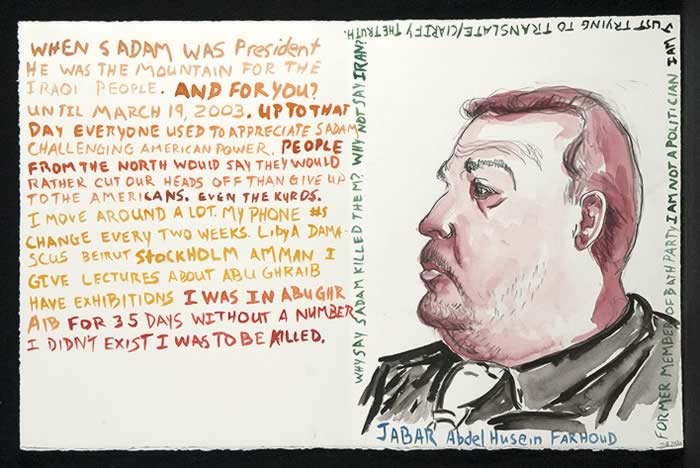 The Abu Ghraib Images of Daniel Heyman Beyond the Hoods:
Three years ago, Seymour Hersh wrote Torture at Abu Ghraib for The New Yorker which along with photos taken by servicemen and woman, burned an image of hooded, tortured and humiliated war detainees into my mind forever. While this iconic image of hooded figures has become an symbol for political cartoons and anti war t-shirts, it has become detached from the horrific story from which it originated.
Artist Daniel Heyman, began incorporating renderings of hooded figures into silkscreen prints and etchings following The New Yorker article in spring 2004. He came to realize the depersonalization and loss of relevance and impact.
It was a serendipitous meeting with Susan Burke, lead attorney in a reparations lawsuit against civilian interrogators and translators at Abu Ghraib, which led him to an invitation to join Burke’s legal team on a trip to Amman, Jordan. Depositions from former prisoners were to be taken and Heyman would sit in on the interviews and create drypoint etchings. For nearly a full week in Amman he listened to dozens of men and women relive their most hideous physical and emotional abuse under humiliating interrogations. He also joined Burke’s legal team for a duplicate round of depositions in Istanbul following in August. Working quickly, Heyman captured words as well as images. His own perspective is embedded in the work: In drypoint etching the copper plates are scratched into with a stylus in reverse so when printed they become "right-reading". He began drawing their faces as the interviews commenced. He listened to the reporting of biographical information through the translator, their marital status, the number of children they had, where they lived, but mostly Heyman concentrated on getting a good start on the portrait. They were often in prison many months, and the nature of these interviews was a recitation of the entirety—as much as they could remember—of all that time. Heyman had to listen, and alternate between capturing their image with documenting
These men and woman, once hooded and faceless, had become personality less global icons. It was in this interview and portraiture process, these Iraqis one by one began to regain their humanity...their faces...their voices.
Thursday, March 27, 2008

Malcolm Bray is a painter and print maker born November 2, 1958 in Hull, England.
He emigrated to the United States in May 1984. He presently resides in Delaware Township, NJ and was the former owner of Old English Pine (antique furniture imports) in Lambertville, New Jersey. In March of 2004, Bray gave up his import business of 19 years to concentrate full-time on his art career. He can be found working from his second floor studio/gallery above his former company in Lambertville.
From this spacious loft, Bray has organized annual group art exhibitions since 1994, and the participating group is identified as New Eclectic. This group also displayed at MCS Gallery, Easton, Pennsylvania in 2003 and West Chester University, Pennsylvania in 2004. This particular exhibition has included many artists from the local community and others from the region. In the last two years these artists included Rachel Bliss, Luis Bujalance, Jacques Fabert, Harry Georgeson, James Groody, Michael Hale, Diane Levell, Bonnie Maclean, Pat Martin, Barry Snyder and Mitchell Yarmark and Bray. Bray hoped the viewer would consider these exhibitions as "one unit" while at the same time acknowledging each artist's distinctive style.
During the summer of 2004, Bray attracted the attention of Cheryl Hazan Gallery in New York and is also represented by Morpeth Gallery in Hopewell, New Jersey. His present abstraction is spontaneous but structured in a way that elements within the composition evoke the dimensional aspects of volume and space. There is a clear relationship between his work and that of the New York Abstract Expressionists.
Art and Technology Integrated in Julius Popp's
Bitfall installation at MOMA
Using technological wizardry, Julius Popp’s Bitfall reproduces the ‘flood’ of media information in the form of a real waterfall. Comprised of 128 nozzles, Popp’s curtain collects a continuous stream of water droplets. Directing their flow with a complex system of magnetic valves controlled by computer, text and graphics randomly selected from the internet appear in the drizzling liquid, creating a DIYplasma screen. As each message drips into a collection tank, its feeds back into the cycle, creating a metaphor for the impermanence and flux of the perception of ‘reality’. At MOMA February 24–May 12, 2008 at the Design and the Elastic Mind Exhibit.
A short documentary about Julius Popp’s BitFall project Julius Popp at UNION Gallery
How to reach Julius Popp Official site
The Graphical Waterfall ® was invented by Stephen Pevnick, a professor of computer art at the University of Wisconsin in Milwaukee, Wisconsin, USA.
When Pevnick was a graduate student, he became interested in exploring nature at a very rare and beautiful moment as art. In 1973 (the year Popp was born) he began experimenting with sound and space using a computer to produce falling water droplets to make sound on a drum. Upon producing sound he noticed that with proper timing it was possible to build falling images in space!
In 1974 Pevnick received a grant from the University of South Florida to explore the idea of forming graphics in free falling water droplet images. In 1977 he produced the first three dimensional computer controlled waterfall image, a falling diamond, on a machine which would evolve into today’s Graphical Waterfall®. The valve system was a horizontal square, 4 feet by 4 feet and had an 8 nozzle by 8 nozzle grid totaling 64 nozzles. At the University of Wisconsin - Milwaukee, where Pevnick began teaching in 1978, he was able to develop the first one foot square graphic producing waterfall with the help of a National Endowment for the Arts, Design Arts, Project Fellowship. In 1982 he developed the technology to spell with letters in English and Western languages using free falling water droplets and in 1983 he won one of 10 Design Excellence Awards from the Industrial Designer’s Society of America at their National Conference in Chicago.
The Graphical Waterfall(r) was first exhibited with the Klein Gallery in 1988 at the International Art Exhibition at Navy Pier in Chicago. The waterfalls were called the “Rainfall Project” until the 1990’s when the name was changed to Graphical Waterfall®. Early ideas about nature at a very rare and beautiful moment as art evolved into the idea of “painting” graphics and words with water. The resulting Graphical Waterfalls® make kinetic graphics like lines, shapes and multiple dancing ribbons which are a synthesis of art and nature. When a Graphical Waterfall® is programmed, there are always kinetic graphics interspersed among the words and logos to keep an element of surprise or mystery which keeps viewers watching and waiting to see what will come next. Pevnick’s current research centers around real-time multimedia and computer controlled kinetic sculpture and water. As the artist and designer, Pevnick oversees the graphical content so that the waterfall maintains a unique aesthetic. The Graphical Waterfall®, when installed in a large public venue, blurs the boundaries between Art, Design and Theater and provides viewers with a unique unforgettable experience.
Subscribe to:
Posts (Atom)
To Purchase New Book, "MITCHELL", refer to the right hand margin BLURB widget


